
 Resources Hub
- Covering stress, sleep, digestive discomfort, longevity strategies, & much more
- Click here to Request initial wellness conversation
- Click here to Message Kate (Feedback, Resources Hub request, etc.)
- Need to call? 1-813-563-0737
Information • Insight • Ideas • Incentives • Inspiration ...
Resources Hub Welcome
This Resources Hub is meant to offer various content and materials to inform, inspire, and promote insight, ideas, and incentives to keep you in-the-know, motivated, and progressing to ever better health & wellness.
Content may include myth-busting facts, new or in-the-news information you may find interesting, resources of possible help, materials or tips you may find useful. The purpose is to refresh, relax, invigorate, motivate, or simply share fun facts hoping to prompt a smile (for simple joys nourish spirit and wellbeing).
To request some type of content/materials for this page, use the "Message Kate" feature on our Contact webpage, mark it as a "Request for the Resources Hub," and tell us what you'd like to see here.
If you're offering content or materials to share, please make sure they're free and clear to share (no copyright infringements, no breach of confidentiality/privacy, no infringement of intellectual property or other laws or protected rights). When you offer content/materials to share and it appears on this webpage, we'll name you as the source in our note of appreciation to you.
Information
The importance of sleep for wellness
Our bodies and minds use sleep-time to care for themselves in a number of ways. That’s why it’s important to routinely get enough sleep and make sure it’s good quality sleep. Occasional exceptions are expected, but your typical sleep life needs to give your body and mind sufficient quality and time for “rest and recovery” to take care of itself. And “rest and recovery” means your body isn’t busy stressing or digesting foods/beverages (digestion can take 2 hours and longer!).

Enough good-quality “rest and recovery” sleep:
- -Enables the body to work on repairing and healing itself;
- -Enables the brain to process, organize, and consolidate all the information and learning you took in during the day, and then form and store memories and new learning; and
- -Lets your body and mind refresh to handle your next day.
Getting enough good-quality sleep (or deprivation of it) is said to affect our immune system, focus, creativity, learning, decision making, the body’s production and use of hormones, moods and emotions, and might even be one culprit in unexplained weight gain or inability to lose weight. Caution: Health concerns should always be discussed timely with an appropriate medical professional.
[The above is an excerpt from The Purpose of Sleep in my QuickGuide paper, Sleep and Wellness]
Inspiration
Thoughts inspire mood, emotions, feelings, incentive, decisions, actions, and your life and health. When a thought pops into your mind, you are free to evaluate it, decide whether it's nourishing or damaging, and then choose whether to hold on to it or replace it with a more nourishing thought. For better health and wellbeing choose thoughts about:
"...whatever is truth, whatever is honorable,
whatever is just, whatever is pure, whatever is lovely,
whatever is gracious, whatever is commendable;
if anything is excellent or worthy of praise;
think about these things..."*
For, as many admirable sources** have said in various ways:
thoughts lead to words
words lead to actions
actions lead to habits
habits lead to character
character leads to destiny
And: as a man thinks, so he is.***
So dismiss the damaging thoughts and hold on to healthy nourishing thoughts for wellbeing.

*Phil 4:8
**Ralph Waldo Emerson, Chinese philosopher Lao Tzu, spiritual teacher Gautama Buddha, Proverbs, and more
**Proverbs 23:7
Spotlight Feature
Good-bye Procrastination...Hello Action
The following is a freely-available online message from Mel Robbins, author of a stimulating little book called The 5 Second Rule. Mel offers a technique that may help you overcome procrastination so you act on the steps to your goals. I both enjoyed reading the book and found its underlying message and technique interesting as well as helpful.
- The 5 Second Rule is simple. If you have an instinct to act on a goal, you must physically move within 5 seconds or your brain will kill it.
- The moment you feel an instinct or a desire to act on a goal or a commitment, use the Rule.
- When you feel yourself hesitate before doing something that you know you should do, count 5-4-3-2-1-GO and move towards action.
- There is a window that exists between the moment you have an instinct to change and your mind killing it. It’s a 5 second window. And it exists for everyone.
- If you do not take action on your instinct to change, you will stay stagnant. You will not change.
- But if you do one simple thing, you can prevent your mind from working against you. You can start the momentum before the barrage of thoughts and excuses hit you at full force.
- What do you do?
- Just start counting backwards to yourself: 5-4-3-2-1.
- The counting will focus you on the goal or commitment and distract you from the worries, thoughts, and excuses in your mind.
- As soon as you reach “1” – push yourself to move.
- This is how you push yourself to do the hard stuff – the work that you don’t feel like doing, or you’re scared of doing, or you’re avoiding.
- That’s it. 5 seconds is all it takes.
- If you don’t act on an instinct within that 5 second window, that’s it. You’re not doing it.
In her book, Mel goes further explaining the why and how of her story, concept, and technique. If it sounds enticing or promising to you, check out more about Mel Robbins and her book, The 5 Second Rule, available through Amazon or Barnes & Noble or Indiebound.
P.S. Check out our Ideas section for another way Mel's concept might help you work toward your desired goals.
Insights
Sugar for wellness
Without the right types & amounts of sugar, we can truly physically die. Too little sugar starves our cells (which need some glucose-sugar for life energy) and we risk losing consciousness, having seizures, even dying. However, too much sugar strains and can damage our body in various areas and we risk liver complications, kidney disease, addictions, aging skin, blood pressure problems, and many more discomforts and diseases and also possibly death.
In the US, the typical daily sugar intake is in the Sugar Danger Zone. Note:
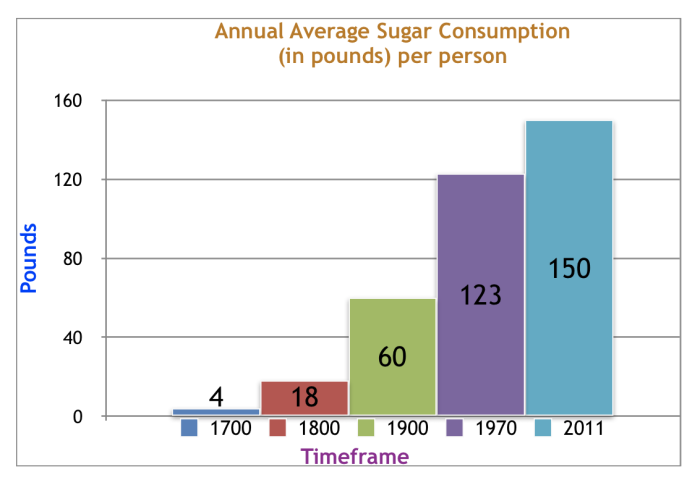
- The US average annual per-person sugar consumption has skyrocketed -- Up from 4 lbs a year per person (1700s) to over 150 lbs a year per person in 2011! [1].
- FYI: 1 pound of granulated sugar = 108.86 teaspoons [2] so the 2011 annual sugar consumption converted to daily consumption is, per person, 44.7 teaspoons of sugar each day.
- That far exceeds the AMA, FDA, and World Health Organization recommend daily sugar consumption - they say keep sugar to less than 6-12 teaspoons a day! [3]
- Sugar is being added to about 74% of US packaged/processed foods including unexpected sources like sandwich breads, savory sauces, even many “healthy” foods. [4]
- With about 60 different types and names for sugar, many of us don't realize we're eating so much sugar. [See below a list of "The Many Names of Sugar"]
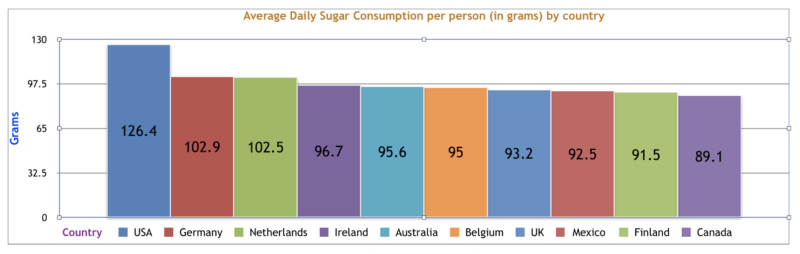
- People in the US consume far more sugar daily than those in other countries. [5]
I'm not saying never enjoy special occasions where sweets abound BUT: what's your typical daily sugar consumption? You might be unpleasantly surprised.
Check food ingredients and nutrition content. Look for the various names used for sugar. How much sugar is in your typical foods? How much sugar are you routinely eating daily, weekly, yearly? Become more aware. Choose wisely. Avoid a “Sugar Danger Zone” harmful to your wellbeing.
P.S. Some sugars are "safer" than others, but that's another complex story.
Footnotes and Sources:
[1] “45 Alarming Statistics on American’s Sugar Consumption and the Effects of Sugar on Americans’ Health” by TheDiabetesCouncil.com found at: https://www.thediabetescouncil.com/45-alarming-statistics-on-americans-sugar-consumption-and-the-effects-of-sugar-on-americans-health/ AND Avail Clinical Research at Accel Research Sites at: https://accelresearchsites.com/sugar-rush-how-sugar-consumption-is-changing-america-infographic/
[2] Granulated sugar conversions by Traditional Oven retrieved from: https://www.traditionaloven.com/culinary-arts/sugars/granulated-sugar/convert-pound-lb-granulated-white-sugar-to-tea-spoon-tsp-granulated-sugar.html
[3] "A Day's Worth of Sugar in a Single Food" The Atlantic retrieved from https://www.theatlantic.com/health/archive/2015/11/meals-you-can-eat-to-get-enough-sugar/415344/ and "Hidden in Plain Sight: Added sugar is hiding in 74% of packaged foods" SugarScience retrieved from https://sugarscience.ucsf.edu/hidden-in-plain-sight/#.XdxQjZNKiL_
[4] "Hidden in Plain Sight: Added sugar is hiding in 74% of packaged foods" SugarScience retrieved from https://sugarscience.ucsf.edu/hidden-in-plain-sight/#.XdxQjZNKiL_
[5] Washington post article at https://www.washingtonpost.com/news/wonk/wp/2015/02/05/where-people-around-the-world-eat-the-most-sugar-and-fat/ found via “45 Alarming Statistics on American’s Sugar Consumption and the Effects of Sugar on Americans’ Health” by TheDiabetesCouncil.com at: https://www.thediabetescouncil.com/45-alarming-statistics-on-americans-sugar-consumption-and-the-effects-of-sugar-on-americans-health/
The Many Names of Sugar
excludes artificial sweeteners
Basic Simple Sugars:
- Dextrose
- Fructose
- Galactose
- Glucose
- Lactose
- Maltose
- Sucrose
Solid or Granulated Sugars:
- Barbados sugar
- Beet sugar
- Brown sugar
- Cane juice crystals
- Cane sugar
- Caster (or castor) sugar
- Coconut sugar
- Coconut palm sugar
- Confectioner’s sugar (a/k/a powdered sugar)
- Corn sweetener
- Corn syrup solids
- Crystalline fructose
- Date sugar
- Demerara sugar
- Dextrin
- Diastatic malt
- Ethyl maltol
- Florida crystals
- Golden sugar
- Glucose syrup solids
- Grape sugar
- Icing sugar
- Maltol
- Maltodextrin
- Muscovado sugar
- Panela sugar
- Raw sugar
- Saccharose
- Sugar (granulated or table)
- Sucanat
- Turbinado sugar
- Yellow sugar
(...continuation) The Many Names of Sugar
excludes artificial sweeteners
Liquid or Syrup Sugars
- Agave Nectar/Syrup
- Barley malt
- Blackstrap molasses
- Brown rice syrup
- Buttered sugar/buttercream
- Buttered syrup
- Caramel
- Carob syrup
- Corn syrup
- Dehydrated cane juice
- Evaporated cane juice
- Free-flowing brown sugar
- Fruit juice
- Fruit juice concentrate
- Golden syrup
- High-Fructose Corn Syrup (HFCS) is made from corn starch and has been found to create many health concerns
- Honey
- Invert sugar
- Malt syrup
- Maple syrup
- Molasses
- Rice syrup
- Refiner’s syrup
- Sorghum syrup
- Sweet sorghum
- Syrup
- Treacle
More Sugars
- Mannose
- Palm sugar, palmyra palm, date palm, nipa palm
- Panocha

Incentive
There are so many different types of Incentives: reward/happiness, punishment/pain, extrinsic, intrinsic, moral, legal, with a group, between two people, within one person, etc.
Why so many? Because, just like bio-individuality affects what particular foods, medicines, supplements, and lifestyle habits work for you specifically, not all incentives work for everyone nor every time.
- Different people need different types of incentives.
- And the same one person can need different types incentives depending on the time, place, people, and circumstances involved.
BUT there's one common truth: each and all incentives are intended to entice, stimulate, provoke, or prompt the person(s) to do something (which, in some cases, means choosing to avoid or not do something) in order to achieve a desired result.
Hhmmmm......Maybe Mel Robbin's
5-Second Rule is a tactic that could work for you?
Are you (or do you fear) struggling with a health/wellness goal that you think is or will be failing miserably?
- Perhaps you need a different type of incentive that will work for you at this time, place, and circumstance involved.
- Maybe the goal isn't designed correctly for you.
As your Health & Wellness Coach, together we can collaborate on what will work for you now in context of the relevant circumstances, people, places, and realities involved.
And I can help hold you accountable and guide you around expected obstacles and through the tough times.
Consider these incentives. Let me help you Make Better Results Easier ©2019.
Advance your wellness journey now:
Request an initial Wellness Chat